How Long Does Probate Take in Ohio? Can You Sell a House Before Probate Is Finished?
If you inherited a house in Ohio, you may be wondering how long probate will take and whether the property has to sit untouched until the entire estate is closed.
The short answer is: you do not always have to wait until probate is finished to sell an inherited house in Ohio.
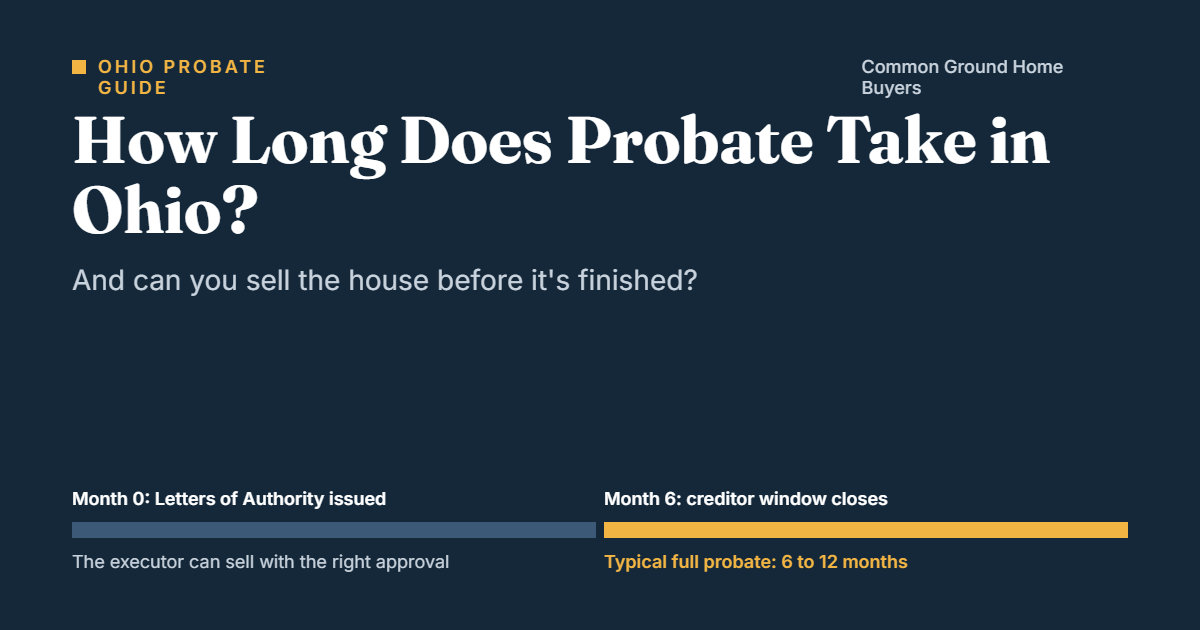
Ohio Legal Help says full probate administration can take approximately 6 months to a year, and some complicated estates can take years. However, the house itself may sometimes be sold earlier if the executor or administrator has the legal authority to complete the sale.
That authority may come from the will, written consents that satisfy Ohio law, or authorization from the probate court.
The important distinction is this:
Selling the house and closing the probate estate are not necessarily the same event.
A property may be sold while the estate remains open for debts, claims, accounting, taxes, and final distributions.
This guide explains how long probate can take in Ohio, when an inherited house may be sold, what authority an executor needs, what happens to the sale proceeds, and how heirs can compare listing the property with selling it as-is.
Important: This article provides general information about Ohio probate and real estate. It is not legal advice. Probate cases vary, so executors, administrators, beneficiaries, and heirs should have an Ohio probate attorney review their specific estate before signing a real estate contract.
Quick Answer: How Long Does Probate Take in Ohio?
For a full probate administration, 6 months to a year is a useful general planning range, according to Ohio Legal Help. More complicated estates may remain open much longer.
Smaller qualifying estates may be eligible for procedures such as release from administration or summary release from administration, which can avoid parts of full administration. The exact processing time depends on the estate and the probate court, so there is no reliable statewide promise that these procedures will finish within a specific number of weeks.
Ohio currently allows release from administration in certain estates valued at $35,000 or less, or up to $100,000 in qualifying surviving-spouse situations.
The key point for a homeowner is that the probate case may remain open even after the inherited house has been sold.
Why Probate Can Take Several Months
Probate involves much more than deciding who receives a house.
The probate court may need to validate a will, appoint a fiduciary, identify beneficiaries, inventory assets, address debts, deal with real estate, complete accounting requirements, and eventually authorize final distributions.
Ohio Legal Help describes the executor or administrator as a fiduciary who must act in the interest of the estate. The fiduciary identifies property and debts, handles required notices and accounting, pays valid estate obligations, and ultimately distributes remaining assets.
A simple estate with cooperative beneficiaries and organized records may progress relatively smoothly.
A case involving disputed ownership, creditor claims, missing beneficiaries, real estate problems, liens, contested wills, or family disagreements may take considerably longer.
A Typical Ohio Probate Process
The exact sequence varies, but most full administrations involve several major stages.
1. Open the Estate
Probate generally begins in the probate court for the county where the deceased person lived.
If there is a will, it is submitted to the court. Someone then applies to administer the estate.
When the person was named in a will, that fiduciary is generally called the executor. When there is no will or no qualifying executor, the court may appoint an administrator.
The appointment matters because simply being an heir does not automatically mean someone has authority to sell real estate belonging to the probate estate.
2. Identify the Estate's Assets
The fiduciary must determine what the deceased person owned.
That may include bank accounts, vehicles, investments, personal property, business interests, and real estate.
Ohio Revised Code Section 2115.02 generally requires an executor or administrator to file an inventory within three months after appointment, unless the probate court grants an extension for good cause. The inventory includes the decedent's Ohio real property and other assets that are being administered.
This becomes particularly important when an inherited house will be sold because the property and its value may affect the available sale procedure.
3. Handle Creditor Claims
Creditor claims are another important part of the probate timeline.
Under Ohio Revised Code Section 2117.06, creditors generally must present claims within six months after the date of death.
That six-month period runs from the date of death, not from the date probate was opened or the executor was appointed.
This does not mean that every estate must remain open for exactly six months before anything can happen, and it does not automatically prevent an inherited house from being sold earlier.
It does mean that creditor rights need to be considered as part of estate administration.
4. Manage Estate Property
While probate is pending, someone still has to take care of the house.
That can mean dealing with insurance, utilities, property taxes, mortgage payments, security, lawn care, weather-related maintenance, and necessary repairs.
If the property is empty, these expenses can continue for months while the estate remains open.
Our guide to selling a vacant house in Ohio explains some of the additional issues owners may face when a property is sitting unoccupied.
5. Pay Obligations and Distribute the Estate
Valid estate obligations must be addressed before the remaining estate is distributed to the beneficiaries or heirs.
That is why selling a house does not necessarily mean the family can immediately divide the sale proceeds.
The funds may still need to remain in the estate while mortgages, liens, taxes, valid claims, administrative expenses, and other obligations are resolved.
Can You Sell a House Before Probate Is Finished in Ohio?
Yes, in some situations.
The critical issue is whether the executor or administrator has authority to sell the property.
Ohio provides several potential routes.
Route 1: The Will Gives the Executor Power to Sell
A will can give an executor authority to sell real estate.
Ohio Revised Code Section 2113.39 provides that when a qualified executor, administrator, or testamentary trustee is authorized by the will or devise to sell property, a separate probate court sale order is generally not required for the fiduciary to proceed under that authority, unless the power is limited by the will.
This is sometimes referred to as a power of sale.
The wording of the actual will matters.
Before listing the house or accepting an offer, the executor and estate attorney should confirm whether the will provides the necessary authority and whether any restrictions apply.
Route 2: Use Ohio's Written-Consent Procedure
Ohio Revised Code Section 2127.011 provides another possible method of selling estate real estate.
Under this route, the required interested parties must give written consent to the power of sale and those consents must be filed with the probate court.
For an estate with a will, that generally means the surviving spouse and all legatees and devisees. For an intestate estate, it generally means the surviving spouse and all heirs.
The statute also requires a sale under this procedure to be for at least 80% of the appraised value shown in the approved inventory.
The procedure is not effective if a required surviving spouse, legatee, devisee, or heir is a minor.
This is one reason an executor should not accept a cash offer first and investigate probate authority later.
The correct legal route should be identified before the property goes under contract.
Route 3: Ask the Probate Court for Authority to Sell
An executor or administrator may also bring an action asking the probate court for authority to sell real estate.
Ohio Revised Code Section 2127.04 provides several circumstances in which the court can authorize a sale.
One statutory route involves at least 50% of the people interested in the property consenting, written objections representing no more than 25% of the aggregate interests, and the court determining that the sale is in the best interest of the estate.
The statute also provides other circumstances in which a court-authorized sale may proceed, so the exact procedure depends on the estate.
This can become particularly important when not everyone agrees, a person with an interest cannot be located, or the fiduciary does not already have another sufficient power of sale.
Does an Executor Have to Wait Six Months Before Selling?
Not automatically.
This is one of the most common probate misconceptions.
Ohio's six-month creditor-claim period does not by itself create a blanket rule saying an inherited house cannot be sold until six months have passed.
A house may potentially be sold earlier when the fiduciary has legal authority and the applicable probate procedures are followed.
The estate, however, may still need to remain open.
The sale proceeds can continue to be estate property while creditor claims, debts, taxes, accounting, and final distribution are handled.
So these are two separate questions:
Can the house be sold?
and
Can the estate be completely closed and the remaining assets distributed?
They do not always have the same timeline.
Is There a Minimum Price for a Probate Sale?
There is no single percentage that applies to every Ohio probate sale.
The applicable pricing requirement depends on the legal procedure being used.
Under the written-consent procedure in Ohio Revised Code Section 2127.011, the property generally must sell for at least 80% of the appraised value shown in the approved inventory.
Court-authorized sales under Chapter 2127 operate under different rules.
For example, Section 2127.33 generally provides that a court-authorized private sale cannot be for less than the appraised value. Public-auction sales have different statutory minimums, and the court has additional options when an initial sale effort is unsuccessful.
This is another reason heirs should avoid treating a probate property exactly like an ordinary private home sale.
What Happens to the Money After the House Sells?
The sale proceeds generally do not immediately become personal money for the heirs.
In a court-authorized probate sale, Ohio law provides an order for applying the proceeds.
Depending on the estate and the sale, funds may first be used for sale expenses and authorized fees, then taxes and assessments, mortgages, judgments, and other claims according to their legal priority.
Remaining proceeds can then be used for applicable estate obligations before the final estate is distributed.
The simplified way to think about it is:
house sold → proceeds enter the estate process → estate obligations are handled → remaining assets are ultimately distributed
Selling the property can solve the real estate problem without immediately finishing every probate issue.
Does Every Inherited House Have to Go Through Full Probate?
No.
Some assets pass outside probate because of how ownership was structured before death.
Depending on the deed and estate plan, real estate may have survivorship rights or a properly established transfer-on-death arrangement.
Ohio also has procedures that can simplify administration for certain smaller estates.
As noted above, release from administration may be available when estate assets are $35,000 or less, or up to $100,000 in certain surviving-spouse situations.
Ohio also has a separate summary-release procedure for narrowly defined very small estates and certain surviving-spouse situations. Eligibility is technical and should be confirmed rather than assumed.
Before planning a sale, confirm whether the property is actually part of the probate estate.
How to Sell an Inherited House During Probate
Once the family decides that selling may be appropriate, the process should begin with probate authority rather than with marketing.
First, confirm who the court has appointed to administer the estate and obtain the relevant appointment documents.
Next, review the will, if one exists, to determine whether the executor has a power of sale.
If there is no sufficient power in the will, the estate attorney can determine whether the written-consent procedure or a court-authorized sale is appropriate.
The property should also be properly identified and valued through the estate process. This is especially important because appraisal requirements can affect the minimum acceptable price under some probate sale procedures.
After authority is clear, the fiduciary can compare the available ways to sell.
That may mean repairing and listing the property, listing it in its current condition, or comparing a direct cash purchase.
Before signing a contract, confirm that the chosen sale structure satisfies the probate requirements that apply to the estate.
At closing, the title company and estate professionals can handle the transfer and direct the sale proceeds appropriately.
For a broader overview of inheritance issues beyond probate timing, see our guide to selling an inherited house in Ohio.
Should You Repair an Inherited House Before Selling?
Not necessarily.
Some inherited homes are already in good condition and may benefit from full exposure to the traditional real estate market.
Other properties may have been owned for decades and need significant work.
The decision should be based on the likely net result, not simply the potential asking price after renovation.
Consider the cost of repairs, the time required to complete them, contractor availability, continued taxes and insurance, utilities, property maintenance, and the possibility of uncovering additional problems.
If the estate spends $1 on repairs, that does not automatically mean the eventual sale price will increase by $1 or more.
For some properties, renovating first may make financial sense.
For others, selling the house as-is in Ohio may reduce time, upfront expense, and management for the heirs.
Traditional Listing vs. Direct Cash Sale During Probate
Neither option is automatically better.
A traditional listing may make sense when the property is market-ready, the estate has enough time, the heirs want broad buyer exposure, and maximizing potential retail price is more important than minimizing the selling process.
A direct cash sale may be worth comparing when the property needs substantial repairs, is vacant, contains unwanted belongings, has deferred maintenance, or the family wants to reduce the amount of work required before closing.
A cash buyer also does not rely on mortgage underwriting, which can remove some financing-related steps from the real estate transaction.
However, cash does not bypass probate.
The estate still needs the legal authority to sell and must be able to transfer valid title.
A direct cash offer may also be lower than the possible retail price of a fully repaired and market-ready home because the buyer may be taking on repairs, holding costs, and resale risk.
That is why the executor should compare net proceeds, timeline, certainty, repairs, and carrying costs together.
If the inherited property is in Southwest Ohio, our page for cash home buyers in Cincinnati explains how Common Ground approaches local direct purchases and other selling options.
Be Careful With Anyone Who Says They Can “Skip Probate”
A cash buyer cannot simply erase a legal probate requirement.
Be cautious if someone suggests that probate does not matter because they are paying cash or that any heir can sign the property over immediately.
The buyer, executor, title company, and estate professionals still need to establish who has legal authority to convey the property.
A legitimate transaction should expect probate and title requirements to be handled correctly.
What Can Delay an Ohio Probate House Sale?
Even after an estate is opened, several issues can slow down the property sale.
Common examples include:
disagreements among heirs or beneficiaries
unclear authority to sell
missing interested parties
a contested will
unresolved mortgages or liens
title defects
property tax issues
major repairs or structural problems
code violations
an occupied rental property
difficulty valuing the property
incomplete estate records
court approval requirements
One problem can also create another.
For example, a vacant inherited house may develop maintenance problems while heirs are deciding what to do, which can then increase repair costs and make a traditional listing more difficult.
What If the Inherited House Is Vacant?
Vacant probate properties deserve attention early.
While the estate remains open, the house may continue generating property taxes, insurance costs, utility bills, landscaping expenses, maintenance, and security concerns.
Vacancy can also affect insurance requirements, so the fiduciary should make sure the insurer knows the property's actual occupancy status.
If the estate does not plan to keep the house, compare the expected benefit of waiting against the ongoing cost of ownership.
Our guide to selling a vacant house in Ohio goes deeper into that decision.
What If the House Still Has a Mortgage?
An inherited property does not need to be mortgage-free before it can be sold.
The mortgage balance generally needs to be addressed as part of the closing process.
A title or closing professional can determine the required payoff and how much equity, if any, remains for the estate.
The executor should avoid assuming the property's estimated market value is the same as the amount the estate will actually receive.
What If There Are Liens or Other Title Problems?
Liens can materially affect a probate sale.
A title search may uncover mortgages, tax issues, judgments, unreleased liens, ownership discrepancies, or other claims affecting the property.
Some problems can be paid from closing proceeds. Others may need to be corrected or legally resolved before valid title can be transferred.
This is another reason to investigate title early rather than waiting until the estate already has a buyer.
What Costs Should an Estate Compare?
The highest offer is not always the offer that leaves the estate with the highest practical result.
When evaluating a traditional listing, an improvement plan, or a direct sale, compare repair expenses, agent compensation if applicable, title and closing expenses, taxes, mortgage payoff, utilities, insurance, maintenance, and the cost of continuing to hold the property.
Our guide to seller closing costs in Ohio explains many of the transaction expenses homeowners should consider.
The useful number is not simply the sale price.
It is the amount the estate expects to retain after the applicable obligations and selling costs are accounted for.
Selling an Inherited House in Cincinnati During Probate
The Ohio probate rules discussed in this guide also apply to inherited properties in Cincinnati.
A Cincinnati property may be handled through the appropriate probate court while the executor or administrator determines whether the property should be kept, improved, listed, or sold directly.
For a local property, the same sequence applies: confirm legal authority, understand the title, identify estate obligations, evaluate the property's condition, compare realistic selling options, and then choose the path that best serves the estate.
Common Ground Home Buyers is based in Cincinnati and works with property owners dealing with inherited homes, vacant properties, repairs, rentals, and other situations.
If the estate is considering an as-is transaction, you can compare your options with local cash home buyers in Cincinnati.
How Common Ground Approaches Inherited Properties
Common Ground Home Buyers brings more than 20 years of Ohio real estate experience and has purchased 500+ properties.
Inherited properties often involve much more than deciding what a house is worth. Families may be dealing with probate, personal belongings, multiple beneficiaries, deferred maintenance, an empty property, title problems, or ongoing expenses at the same time.
That is why a cash offer should not automatically be treated as the only solution.
Depending on the estate and property, heirs may want to compare three broad paths: selling the house directly in its current condition, improving the property before selling, or listing it on the open market.
If you are researching the company more broadly, you can learn more about Common Ground as Trusted Cash Home Buyers in Ohio.
The Bottom Line
So, how long does probate take in Ohio?
For full administration, about 6 months to a year is a reasonable general range, according to Ohio Legal Help, although complicated estates can take longer and sometimes years.
Ohio also has important deadlines within the process. An executor or administrator generally must file the inventory within three months of appointment unless the court grants additional time, while creditor claims generally must be presented within six months after the person's death.
But those timelines do not necessarily mean an inherited house has to remain unsold until the probate estate is completely closed.
The house may potentially be sold earlier when the fiduciary has proper authority under the will, Ohio's consent procedure, or a probate court order.
For heirs, the practical question is therefore not only:
“When will probate finish?”
It is also:
“When will the estate have authority to sell this house, and which selling option produces the best outcome for the estate?”
Confirm the probate route first. Then compare repairs, ongoing holding costs, selling expenses, timing, and expected net proceeds before deciding how to move forward.
Frequently Asked Questions
How long does probate normally take in Ohio?
Ohio Legal Help says full probate administration can take approximately 6 months to a year. More complicated estates may take substantially longer. There is no guaranteed timeline for every probate case.
Can an executor sell a house before probate is finished in Ohio?
Yes, potentially. The executor or administrator must have legal authority to sell the property. Depending on the estate, that authority may come from a power of sale in the will, written consents satisfying Ohio law, or a probate court order.
Do you have to wait six months before selling a probate house?
Not automatically. Ohio creditors generally have six months after the date of death to present claims, but that period does not by itself prohibit an earlier real estate sale. The executor still needs proper authority and must follow the applicable probate procedure.
Can an heir sell the house before an executor is appointed?
Generally, an heir should not assume they can sell property that is still owned by the probate estate. The appropriate fiduciary authority and title situation should be established first. If the property passed outside probate, the analysis may be different.
Do all heirs have to agree to sell an inherited house in Ohio?
Not in every type of sale. For example, a valid power of sale in a will may provide authority without using the statutory consent procedure. The written-consent procedure under Section 2127.011 does require the specified surviving spouse and beneficiaries or heirs to consent. Court-authorized procedures have different requirements.
Is there a minimum sale price for a probate property?
It depends on the procedure. Ohio's written-consent procedure generally requires at least 80% of the appraised value shown in the approved inventory. Court-authorized sales operate under separate appraisal and pricing rules.
What happens to the money after a probate house is sold?
The proceeds generally remain connected to the estate rather than going immediately to the heirs. Applicable sale expenses, taxes, mortgages, judgments, estate debts, and other obligations may need to be addressed before final distribution.
Can a cash buyer purchase an inherited house during probate?
Yes, if the estate has proper authority to sell and can transfer valid title. A cash purchase can remove mortgage financing from the buyer's side of the transaction, but it does not remove probate requirements.
Can you sell a probate house as-is in Ohio?
Potentially, yes. Once the estate has authority to sell, the property may be marketed or sold in its current condition rather than being fully renovated first. The executor should compare the likely net result and make decisions consistent with their fiduciary responsibilities.
Does every inherited house have to go through full probate?
No. Some property passes outside probate because of the ownership structure, and some qualifying estates may use simplified Ohio procedures such as release or summary release from administration.
What if the inherited house is in Cincinnati?
The same Ohio probate principles apply. Once authority to sell is established, the estate can compare repairing, listing, or selling directly. Homeowners and executors can review Common Ground's Cincinnati cash home buyer options when comparing an as-is direct sale with other approaches.
Should I repair an inherited house before selling it?
It depends on the property's condition, repair costs, available estate funds, ongoing carrying expenses, expected marketability after repairs, and the time the estate can reasonably wait. Compare the expected net result of repairing and listing with selling the property in its current condition before committing estate money to renovations.